

Last night, I had the privilege of playing in a concert with Jenny Oaks Baker, one of the more renowned violinists in the country. We played through her most recent album, Wish Upon a Star - a Tribute to Walt Disney. Playing through the masterfully arranged classics, I was filled with remembered feelings of magic and joy that Disney inspired in me as a young boy. From Mary Poppins to fairy tales with pirates, lions, and magic carpets, these movies will always hold a special place in my heart. In more recent years, Disney has turned to computer animation and 3D graphics, and it continues to create wholesome, entertaining media for the family. But I miss the magic of their traditional animation coupled with memorable songs and magical tales.
 One of the last movies to showcase Disney's traditional animation didn't quite fit the fairy tale mold used for so many decades. It was beautifully drawn, but it didn’t feature the typical array of original songs; and, instead of a well-known, classic tale, it told an original story, one chalk-full of witty one-liners and humor that appealed to a grownup audience as much, if not more so, than a young one. Despite this deviation from the norm, I love The Emperor's New Groove and often find myself repeating the humorous quotes and gags with my family. My favorite character is Kronk, a likable, evil sidekick who is described as "big, dumb, and tone deaf" and “a really, really big, stupid monkey named Kronk”. Despite his poor ability to think critically in key moments, Kronk is faced with several decisions that he must make that bear significant consequences. In the humor of the movie, Kronk is not left to his own devices to make his choices. He is visited by two shoulder-angels who help to guide him in polar opposite moral directions. The angels remain nameless, but for my purposes here we'll call them Maverick and Goose—as a tribute to two other favorite movie characters.
Maverick is a traditional adversarial angel, dressed in red and carrying a trident, with a twisted goatee protruding from his chin and dual horns sticking out of his forehead. Goose, on the other hand, is robed in white, harp in hand, white, fluffy wings spread wide, golden halo adorning his crown. Maverick says, of Goose:
 When debating whether or not to let the Emperor plummet to his untimely demise, Kronk entertains the counsel of his angels. He asks Maverick, "Why should I listen to you?" Maverick confidently answers:
Depending on my mood and demeanor and my present circumstances, these angels may from time to time take on a slightly different likeness. Recently, Goose, hanging out on my left shoulder, has taken on a less-ethereal likeness and is easier to visualize and describe. In fact, he looks like one of Disney's 3 little pigs. He's wearing white overalls that are splattered with gray mud and putty. He has impressive muscles, made strong through hard work. Sweat glistens across his brow and he is holding a dirty spade in one hand and a white brick in the other. Similarly, Maverick, over on my right, has recently undergone a makeover. He's still the attractive, cool, confident celebrity, but he's garbed for a relaxing getaway with dark sunglasses, baggy beach shorts, and a tight shirt stretched across his accentuated muscles, hair bleached and spiked, volleyball in one hand and the other pointed in a "the beach is that way..." pose. I think the reason for the costume change has something to do with a few thoughts that have recently touched me as well as a parable of the Savior that has always been meaningful to me.
When I was a teenager, I had a seminary teacher who paid me a strange and unique compliment. Every time he saw me, he would say, "Mike, you're a rock!" or "Hey, it's the Rock!"
Now I don't believe he was confusing me with a movie star or a professional wrestler. But the memory of that personal nickname has remained with me over the years and given me something to aspire to. You see, that year we were studying the New Testament. And the nickname "Rock" has everything to do with one friend of the Savior. I speak of the man Peter, a man who was given the name Cephas, meaning the "rock", by the Savior himself for his consistency and steadfast, immovable character. Peter was the original Rock. Of him, Christ exclaimed,
 Spencer W. Kimball shared his feelings about an Easter Sunday religious editorial he had discovered where a minister claimed the failing of the presiding authority of the early-day church due to self-confidence, indecision, evil companions, failure to pray, lack of humility, and fear of man. This minister wrote, “Let us as people, especially those who are Christians and claim to abide by the Word of God, not make the same mistakes and fall as Peter fell.” President Kimball was taken aback by this message and related, in response, “As I read this, I had some strange emotions. I was shocked, then I was chilled, then my blood changed its temperature and began to boil. I felt I was attacked viciously, for Peter was my brother, my colleague, my example, my prophet, and God’s anointed. I whispered to myself, ‘That is not true. He is maligning my brother.’”
I can certainly echo some of President Kimball’s sentiment, as Peter is also one of my heroes. Here is a man who was indeed human. But he was full of goodness and ultimately lived up to his special name. As a simple fisherman Peter knew little of heavenly truths. But over time, under the tutelage of the Master, Peter grew in faith and leadership, testimony and courage, understanding and humility. Cephas was indeed rebuked on many occasions by the gentle admonitions of the Lord, but he learned from his errors and grew in faith and learning from each shortcoming. In considering those shortcomings of my brother Peter, I think of the words of Paul who exclaimed, “For my strength is made perfect in weakness. Most gladly therefore will I rather glory in my infirmities that the power of Christ may rest upon me. Therefore I take pleasure in infirmities, in reproaches, in necessities, in persecutions, in distresses for Christ’s sake: for when I am weak, then am I strong.” I love these powerful words, so similar to those of Ether in the Book of Mormon, which consider the positive outcomes of challenging weakness, not with our own strength, but with the power and enabling grace of the Atonement of our Lord and Master which allow our weaknesses—those character flaws that lead us to humility and a reliance on our Savior—to become our greatest strengths.
 What were Peter’s weaknesses—those flaws that would lead any Christian to accuse him of cowardice or of failure? One might remember a man who didn’t have the faith to walk upon the waters after turning his gaze from the Lord. In most cases, I think that one would think on Peter’s vehement triple denial of his acquaintance with Jesus in the courtyard of the palace of Caiaphas. How quick we are to cast judgment, failing to appreciate the incredible faith required to take those first few watery steps! How quick we are to forget that, just hours before his notorious denial, Peter was the first and only disciple to draw his sword in defense of his Master outside of Gethsemane before the Savior’s gentle injunction, “Suffer ye thus far… Thinkest thou that I cannot now pray to my Father, and he shall presently give me more than twelve legions of angels?” That same night, Peter also swore to his Master, “Lord, I am ready to go with thee, both into prison, and to death.” This does not sound like the vain promise of a man who would shortly turn his back on a friend and deny his faith and his testimony. So what was it that drove Peter to fulfill his Master’s fateful prophesy of denial?
I think that it has something to do with two shoulder-angels. Like every one of us, Peter hears one angel who slowly, yet surely, builds both faith and confidence as we are able to tune in to those gentle, fervent whisperings. Perhaps, as that confidence grows, it begins to overshadow the faith as the louder voice of the other angel entices us to overconfidence in ourselves and pride. Through the words of Peter, how many times do we see this confident conviction that no earthly force could conquer the Son of God? Peter clearly knew that, with God, all things are possible! But at times Peter failed to listen to that angel in white, not stopping to consider that, with God, some things are necessary.
Consider the dialogue between Peter and Christ, after the Lord’s prophesy that “he must go unto Jerusalem, and suffer many things of the elders and chief priests and scribes, and be killed, and be raised again the third day.” Said Peter, “Be it far from thee Lord: this shall not be unto thee.” Replied Christ, “Get thee behind me Satan: thou art an offense unto me: for thou savorest not the things that be of God but those that be of men.” This indeed seems a severe rebuke to the disciple. Perhaps instead of calling his devoted follower a devil, Jesus was reminding Peter, and all of us, that to deviate from the divinely appointed Plan of Salvation is to stand alongside Satan, that red angel of darkness who would tell us that salvation can come through other means. Both of my shoulder-angels inspire confidence. The difference lies in whom that confidence is placed. My angel of white, Goose, inspires humility, or confidence in God and confidence in what God can and will accomplish through me; on the other hand, Maverick inspires pride, or confidence in myself, in the flesh, in life in general—as long as life is good. It’s when things get rough that Maverick withdraws and that confidence shatters as I am left to my own devices. Throughout our lives, I think we all drift back and forth between these polar opposite extremes. And both angelic emissaries are working diligently to win us back to their side.
I love the powerful words and emotions conveyed through a musical work entitled The Lamb of God, written by Rob Gardner, one of my favorite inspirational composers. Through music and narration, he tells the story of the last week of our Lord through the eyes of those who were closest to Him. Among others, we hear the song of Peter, our rock and exemplary hero. And as I listen, I can’t help but envision myself in his shoes during those critical hours. Doing so, I ultimately stop wondering why Peter felt to deny his Lord and instead contemplate how those experiences further helped to solidify the man Cephas. I wish to share those words from the music that follow Peter during those horrific days from commitment and confidence to complete denial and isolation, then back to hope and recommitment, and in the end to an unwavering witness of the resurrection of the Lord. As we look in on Peter’s feelings and actions during the Savior’s last week, consider how Peter is being inspired by his shoulder angels and whether his confidence is laced with humility and faith or pride.
 Beginning in the upper chamber where the Passover feast was held, we hear the initial shock and outrage of the Twelve upon learning that one of their number would betray their Lord to His enemies, followed by an inward contemplation and reflection, considering what such a personal betrayal might cost. Sang John, Thomas, and Peter:
 One of the last movies to showcase Disney's traditional animation didn't quite fit the fairy tale mold used for so many decades. It was beautifully drawn, but it didn’t feature the typical array of original songs; and, instead of a well-known, classic tale, it told an original story, one chalk-full of witty one-liners and humor that appealed to a grownup audience as much, if not more so, than a young one. Despite this deviation from the norm, I love The Emperor's New Groove and often find myself repeating the humorous quotes and gags with my family. My favorite character is Kronk, a likable, evil sidekick who is described as "big, dumb, and tone deaf" and “a really, really big, stupid monkey named Kronk”. Despite his poor ability to think critically in key moments, Kronk is faced with several decisions that he must make that bear significant consequences. In the humor of the movie, Kronk is not left to his own devices to make his choices. He is visited by two shoulder-angels who help to guide him in polar opposite moral directions. The angels remain nameless, but for my purposes here we'll call them Maverick and Goose—as a tribute to two other favorite movie characters.
Maverick is a traditional adversarial angel, dressed in red and carrying a trident, with a twisted goatee protruding from his chin and dual horns sticking out of his forehead. Goose, on the other hand, is robed in white, harp in hand, white, fluffy wings spread wide, golden halo adorning his crown. Maverick says, of Goose:
"Don’t listen to that guy. He’s trying to lead you down the path of righteousness. I’m gonna lead you down the path that ROCKS!"
 When debating whether or not to let the Emperor plummet to his untimely demise, Kronk entertains the counsel of his angels. He asks Maverick, "Why should I listen to you?" Maverick confidently answers:
Maverick: “Listen up, big guy. I got three good reasons why you should just walk away… Number one: Look at that guy! He’s got that sissy stringy music thing.”Goose: “We’ve been through this. It’s a harp, and you know it.”Maverick: “Oh, right. That’s a harp; and that’s a dress.”Goose: “Robe!”Maverick: “Reason number two… Look what I can do…” (He then jumps into a one-armed handstand, legs stretched in an impressive, balanced pose)Kronk: (puzzled) “But what does that have to do with anything…?”Goose: (interjecting quickly) “No, no… He’s got a point…”Now, in my simple faith I truly believe that I have two shoulder angels that follow me around daily. I'm not sure that my angels carry harps and tridents… in fact I'm not quite sure what they look like in reality. But to me they are very real. The closest I can come to describing my Goose--my Jimminy Cricket--is using words like white, light, joy, quiet confidence, peace, goodness... My Maverick is a little easier to describe because he looks like a movie star: gleaming smile, slick hair, strong presence. Other words come to mind like desire, confident, attractive, alluring, cool, confident, popular, fun, pleasure... I could go on.
Depending on my mood and demeanor and my present circumstances, these angels may from time to time take on a slightly different likeness. Recently, Goose, hanging out on my left shoulder, has taken on a less-ethereal likeness and is easier to visualize and describe. In fact, he looks like one of Disney's 3 little pigs. He's wearing white overalls that are splattered with gray mud and putty. He has impressive muscles, made strong through hard work. Sweat glistens across his brow and he is holding a dirty spade in one hand and a white brick in the other. Similarly, Maverick, over on my right, has recently undergone a makeover. He's still the attractive, cool, confident celebrity, but he's garbed for a relaxing getaway with dark sunglasses, baggy beach shorts, and a tight shirt stretched across his accentuated muscles, hair bleached and spiked, volleyball in one hand and the other pointed in a "the beach is that way..." pose.
 I think the reason for the costume change has something to do with a few thoughts that have recently touched me as well as a parable of the Savior that has always been meaningful to me.
When I was a teenager, I had a seminary teacher who paid me a strange and unique compliment. Every time he saw me, he would say, "Mike, you're a rock!" or "Hey, it's the Rock!"
Now I don't believe he was confusing me with a movie star or a professional wrestler. But the memory of that personal nickname has remained with me over the years and given me something to aspire to. You see, that year we were studying the New Testament. And the nickname "Rock" has everything to do with one friend of the Savior. I speak of the man Peter, a man who was given the name Cephas, meaning the "rock", by the Savior himself for his consistency and steadfast, immovable character. Peter was the original Rock. Of him, Christ exclaimed,
"Thou art Simon the son of Jona: thou shalt be called Cephas (which is, by interpretation, a stone). Upon this rock I will build my church and the gates of @#!*% shall not prevail against it. And I will give unto thee the keys of the kingdom of heaven: and whatsoever thou shalt bind on earth shall be bound in heaven: and whatsoever thou shalt loose on earth shall be loosed in heaven."Can you imagine what it would feel like to have the Savior of the World speak those words to you? Can you imagine what it must have felt like to Peter? Thinking on this makes me feel pretty special to have been myself called a rock by a loving brother and teacher. Today, I wish to take a few minutes to explore the path that Peter trod through life on his metaphorical journey to Cisthene, land of the rock rose, to stare into the eyes of the serpent-haired Gorgon and fully transform into the firm and unyielding element for which he was named, becoming a man of commitment, testimony, constancy, and steadfastness. And I wish to compare this to my personal journey to rise up to follow the example of my namesake and become a pillar of strength in spite of my ever-present weakness.
 Spencer W. Kimball shared his feelings about an Easter Sunday religious editorial he had discovered where a minister claimed the failing of the presiding authority of the early-day church due to self-confidence, indecision, evil companions, failure to pray, lack of humility, and fear of man. This minister wrote, “Let us as people, especially those who are Christians and claim to abide by the Word of God, not make the same mistakes and fall as Peter fell.” President Kimball was taken aback by this message and related, in response, “As I read this, I had some strange emotions. I was shocked, then I was chilled, then my blood changed its temperature and began to boil. I felt I was attacked viciously, for Peter was my brother, my colleague, my example, my prophet, and God’s anointed. I whispered to myself, ‘That is not true. He is maligning my brother.’”
I can certainly echo some of President Kimball’s sentiment, as Peter is also one of my heroes. Here is a man who was indeed human. But he was full of goodness and ultimately lived up to his special name. As a simple fisherman Peter knew little of heavenly truths. But over time, under the tutelage of the Master, Peter grew in faith and leadership, testimony and courage, understanding and humility. Cephas was indeed rebuked on many occasions by the gentle admonitions of the Lord, but he learned from his errors and grew in faith and learning from each shortcoming. In considering those shortcomings of my brother Peter, I think of the words of Paul who exclaimed, “For my strength is made perfect in weakness. Most gladly therefore will I rather glory in my infirmities that the power of Christ may rest upon me. Therefore I take pleasure in infirmities, in reproaches, in necessities, in persecutions, in distresses for Christ’s sake: for when I am weak, then am I strong.” I love these powerful words, so similar to those of Ether in the Book of Mormon, which consider the positive outcomes of challenging weakness, not with our own strength, but with the power and enabling grace of the Atonement of our Lord and Master which allow our weaknesses—those character flaws that lead us to humility and a reliance on our Savior—to become our greatest strengths.
 What were Peter’s weaknesses—those flaws that would lead any Christian to accuse him of cowardice or of failure? One might remember a man who didn’t have the faith to walk upon the waters after turning his gaze from the Lord. In most cases, I think that one would think on Peter’s vehement triple denial of his acquaintance with Jesus in the courtyard of the palace of Caiaphas. How quick we are to cast judgment, failing to appreciate the incredible faith required to take those first few watery steps! How quick we are to forget that, just hours before his notorious denial, Peter was the first and only disciple to draw his sword in defense of his Master outside of Gethsemane before the Savior’s gentle injunction, “Suffer ye thus far… Thinkest thou that I cannot now pray to my Father, and he shall presently give me more than twelve legions of angels?” That same night, Peter also swore to his Master, “Lord, I am ready to go with thee, both into prison, and to death.” This does not sound like the vain promise of a man who would shortly turn his back on a friend and deny his faith and his testimony. So what was it that drove Peter to fulfill his Master’s fateful prophesy of denial?
I think that it has something to do with two shoulder-angels. Like every one of us, Peter hears one angel who slowly, yet surely, builds both faith and confidence as we are able to tune in to those gentle, fervent whisperings. Perhaps, as that confidence grows, it begins to overshadow the faith as the louder voice of the other angel entices us to overconfidence in ourselves and pride. Through the words of Peter, how many times do we see this confident conviction that no earthly force could conquer the Son of God? Peter clearly knew that, with God, all things are possible! But at times Peter failed to listen to that angel in white, not stopping to consider that, with God, some things are necessary.
Consider the dialogue between Peter and Christ, after the Lord’s prophesy that “he must go unto Jerusalem, and suffer many things of the elders and chief priests and scribes, and be killed, and be raised again the third day.” Said Peter, “Be it far from thee Lord: this shall not be unto thee.” Replied Christ, “Get thee behind me Satan: thou art an offense unto me: for thou savorest not the things that be of God but those that be of men.” This indeed seems a severe rebuke to the disciple. Perhaps instead of calling his devoted follower a devil, Jesus was reminding Peter, and all of us, that to deviate from the divinely appointed Plan of Salvation is to stand alongside Satan, that red angel of darkness who would tell us that salvation can come through other means. Both of my shoulder-angels inspire confidence. The difference lies in whom that confidence is placed. My angel of white, Goose, inspires humility, or confidence in God and confidence in what God can and will accomplish through me; on the other hand, Maverick inspires pride, or confidence in myself, in the flesh, in life in general—as long as life is good. It’s when things get rough that Maverick withdraws and that confidence shatters as I am left to my own devices. Throughout our lives, I think we all drift back and forth between these polar opposite extremes. And both angelic emissaries are working diligently to win us back to their side.
I love the powerful words and emotions conveyed through a musical work entitled The Lamb of God, written by Rob Gardner, one of my favorite inspirational composers. Through music and narration, he tells the story of the last week of our Lord through the eyes of those who were closest to Him. Among others, we hear the song of Peter, our rock and exemplary hero. And as I listen, I can’t help but envision myself in his shoes during those critical hours. Doing so, I ultimately stop wondering why Peter felt to deny his Lord and instead contemplate how those experiences further helped to solidify the man Cephas. I wish to share those words from the music that follow Peter during those horrific days from commitment and confidence to complete denial and isolation, then back to hope and recommitment, and in the end to an unwavering witness of the resurrection of the Lord. As we look in on Peter’s feelings and actions during the Savior’s last week, consider how Peter is being inspired by his shoulder angels and whether his confidence is laced with humility and faith or pride.
 Beginning in the upper chamber where the Passover feast was held, we hear the initial shock and outrage of the Twelve upon learning that one of their number would betray their Lord to His enemies, followed by an inward contemplation and reflection, considering what such a personal betrayal might cost. Sang John, Thomas, and Peter:
Lord, is it I?
Would ever I betray Thee?
Having known Thy love, could I so cruelly turn away?
Could my heart so fail Thee and my feeling turn so cold?
If I should leave Thee, where would I go?
Lord, is it I?
Am I then to betray Thee?
Having seen Thy wonders, could my foolish heart be swayed?
Is my faith so little that my soul would cease to burn?
If I should wander, where would I turn?
If I am prone to leave Thee,
If I am wont to doubt,
Oh, wilt Thou still receive me,
Bind me fast!
Oh, find me out!
That I may never wander,
That I may ever see,
Oh, that my hope seek not but Thee!
That I might follow with Thee!
Lord, is it I?
Could ever I betray Thee?
Having followed with Thee, could I seek some other way?
Though my heart is willing, could my flesh become so weak?
If I should leave Thee, whom would I seek?
O Savior, Take Thou my weakness from me!
Help Thou my unbelief!
Let nothing overcome me!
Be Thou with me! My sure relief!
Thou art my only Shepherd.
Thou art the only Way.
Oh, may I ever serve Thee…
For it is I who owe Thee my devotion.
It is I, yes I, so safely folded in Thy care.
Let mountains fall! Let earth divide!
Let valleys rise!
Yet one thing shall I know:
I will not leave Thee…
If I should leave Thee, where would I go?
What powerful words sung by those who best knew the Savior. I love the subtle progression from confusion and contemplation to firm commitment. “Lord, is it I? Could I possibly be the one? How could I ever abandon the truth?” Can you hear the hesitation, the fear of failing to stand fast? Can you guess which shoulder-angel is inspiring this doubt? But then faith again takes root… “Lord, it is I who will never fail thee! There is no force on earth that could take me from thee!” Those three simple words, slightly reordered, convey such opposite convictions. Is it I?... It is I!
As the Last Supper progress, Peter reaffirms his devotion to his Lord, singing:
As the Last Supper progress, Peter reaffirms his devotion to his Lord, singing:
Though all men be offended,
Yet shall I never be…
I’ll go with Thee to prison if Thou asketh it of me,
Though I should die with Thee,
Yet will not I deny Thee.
Yet shall I never be…
I’ll go with Thee to prison if Thou asketh it of me,
Though I should die with Thee,
Yet will not I deny Thee.
Can you hear that conviction? It is I!
 As the night progressed and enemies drew near, Peter found that he was the only man holding a sword ready to fight back. Christ had power to raise the dead! Christ, himself, admitted that He could call down twelve legions of angels! So why didn’t he? Was Peter’s confidence at this point tuned to events set in motion that were much greater than he knew and understood? Or had his confidence been so deeply placed in the wonder of miracles and the almighty power of his Lord that he never truly believed that anything bad could and would happen to his Master or himself? If his confidence was of the prideful sort, Peter was not an unrighteous man. Perhaps, though, too many times he had given heed to the voice of an angel of darkness who suggested that things might happen his way, in his time, according to his desires. Along with the other disciples that fled, Peter’s Maverick withdrew, leaving Peter alone and confused, his confidence fading away with the torch lights of the oppressing mob. Despite his confusion and fear, Peter steadfastly follows his Master into a den of enemies. He intones:
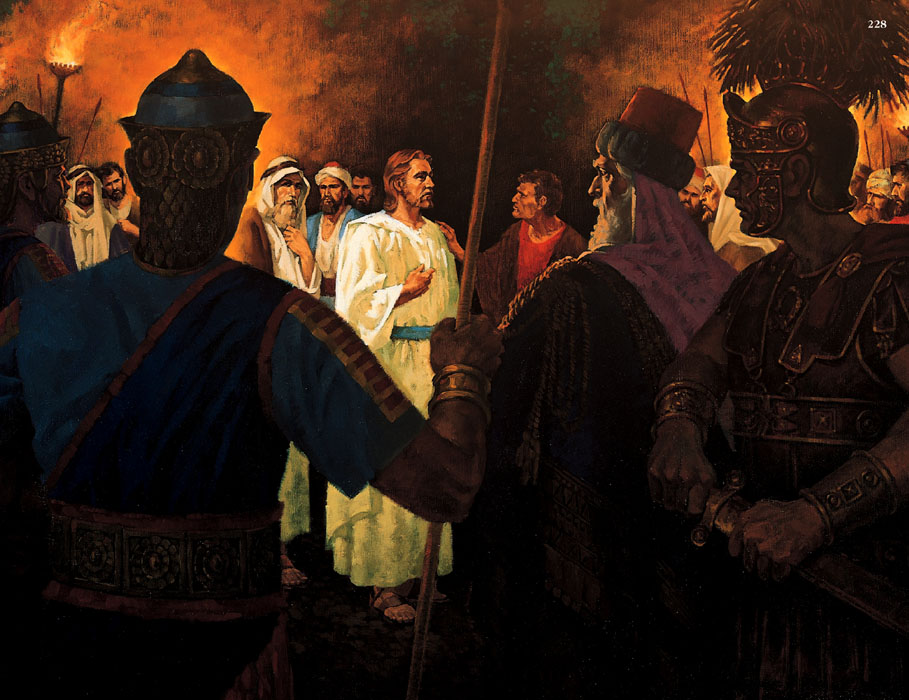 As the night progressed and enemies drew near, Peter found that he was the only man holding a sword ready to fight back. Christ had power to raise the dead! Christ, himself, admitted that He could call down twelve legions of angels! So why didn’t he? Was Peter’s confidence at this point tuned to events set in motion that were much greater than he knew and understood? Or had his confidence been so deeply placed in the wonder of miracles and the almighty power of his Lord that he never truly believed that anything bad could and would happen to his Master or himself? If his confidence was of the prideful sort, Peter was not an unrighteous man. Perhaps, though, too many times he had given heed to the voice of an angel of darkness who suggested that things might happen his way, in his time, according to his desires. Along with the other disciples that fled, Peter’s Maverick withdrew, leaving Peter alone and confused, his confidence fading away with the torch lights of the oppressing mob. Despite his confusion and fear, Peter steadfastly follows his Master into a den of enemies. He intones:
The others flee,
How soon He is forsaken.
And shall I flee?
Abandon Him to face this all alone?
But He won’t fight.
Is He willing to allow this foul deceit?
Still, I must follow…
I will not run.
How soon He is forsaken.
And shall I flee?
Abandon Him to face this all alone?
But He won’t fight.
Is He willing to allow this foul deceit?
Still, I must follow…
I will not run.
Can you hear the underlying hope and resolve to struggle onward, perhaps laced with fear or a lack of confidence? Then came that fateful hour where Peter condemned himself in the eyes of many Christians to this day. We listen in:
Now Peter had followed Jesus afar off and sat without in the palace: and a damsel came unto him.
Damsel: I know thy face…
Thou wast with Jesus of Galilee!
Peter: I know…
I know not…
I know not what thou sayest!
Maid: This fellow here:
This fellow here was with Jesus of Nazareth.
I’ve seen him there also…
Peter: I swear to you:
No, I do not know the man!
Damel & Maid: But surely thou also art one of them…
Surely thou followed with Jesus…
Thy speech is of Galilee…
I’ve seen you there also…
Yes, thou wast with Jesus of Galilee…
Thou wast with Jesus of Nazareth…
Peter: I know not the man!
Damsel: I know thy face…
Thou wast with Jesus of Galilee!
Peter: I know…
I know not…
I know not what thou sayest!
Maid: This fellow here:
This fellow here was with Jesus of Nazareth.
I’ve seen him there also…
Peter: I swear to you:
No, I do not know the man!
Damel & Maid: But surely thou also art one of them…
Surely thou followed with Jesus…
Thy speech is of Galilee…
I’ve seen you there also…
Yes, thou wast with Jesus of Galilee…
Thou wast with Jesus of Nazareth…
Peter: I know not the man!
 And with the crowing of the morning @#!*% , Peter fled the palace in shame. I have not openly denied my Savior in word but, through sins of omission and commission, I have committed numerous offenses to my Lord that are every bit as self-condemning as anything Peter, the Rock, may have done this night. His words of pain and torment echo so strongly with me. Sang Peter:
What have I done?
Denied Him?
What have I done?
So now am I no different from the men
Who take thy bread then turn again? Oh…
What have I done?
I hear their filthy tongues, their vicious scorn,
The lies they spin with Satan’s yarn.
I watch them spit and strike Thy face,
They mock Thy name in foul disgrace.
And when Thou lookest for a friend,
Thou findest none, for I have fled,
Oh God!
What have I done?
As Thou hast taken stripes for me,
Could I not take but one for Thee?
I cannot watch them take my Lord.
I can’t endure their cruel hands upon Him,
While his own hands are tied with cord,
Those hands with pow’r to raise the dead,
Command the storm, now bound instead, and
I cannot hear them mock His name.
I cannot bear their foul breath upon Him.
I dare not look upon His face
And see the very Son of God,
His brow so bruised and stained with blood
His eyes that shed my sorrow’s tears,
And watch as all hope disappears.
I will not watch them crucify my Lord!
For I know this Man!
I know Him!
I know this Man!
I cannot watch what He must bear.
For surely He must carry all my burden.
Forgive me, Lord, that I’m not there…
But, when my eyes are closed in death,
These words will hang on my last breath:
I know Him.
Denied Him?
What have I done?
So now am I no different from the men
Who take thy bread then turn again? Oh…
What have I done?
I hear their filthy tongues, their vicious scorn,
The lies they spin with Satan’s yarn.
I watch them spit and strike Thy face,
They mock Thy name in foul disgrace.
And when Thou lookest for a friend,
Thou findest none, for I have fled,
Oh God!
What have I done?
As Thou hast taken stripes for me,
Could I not take but one for Thee?
I cannot watch them take my Lord.
I can’t endure their cruel hands upon Him,
While his own hands are tied with cord,
Those hands with pow’r to raise the dead,
Command the storm, now bound instead, and
I cannot hear them mock His name.
I cannot bear their foul breath upon Him.
I dare not look upon His face
And see the very Son of God,
His brow so bruised and stained with blood
His eyes that shed my sorrow’s tears,
And watch as all hope disappears.
I will not watch them crucify my Lord!
For I know this Man!
I know Him!
I know this Man!
I cannot watch what He must bear.
For surely He must carry all my burden.
Forgive me, Lord, that I’m not there…
But, when my eyes are closed in death,
These words will hang on my last breath:
I know Him.
With all of my weaknesses, so much more condemning and damning than any denial by Peter, I don’t feel that I could have worthily stood beside the cross as Christ sacrificed so greatly for my unworthiness, hoping that I might truly find in my weakness my greatest strength.
Through the grace and mercy of God, Peter was given another chance to stand before his Lord and Master. Three days later and numerous times in the following weeks and months, Peter—Cephas—was given the opportunity to prove his repentance and his true devotion to the Master. And in my faith, I know that I, too, will one day have that same opportunity to look into my Savior’s eyes and thank Him for His great sacrifice while providing an accounting of my service to Him as a product of my heartfelt repentance.
 One final time, let us look into the life of Peter and consider his confidence and commitment. From a fishing boat, Peter recognized the call of his Lord from the shore and threw himself into the water to hurry to be with Jesus. That night, over a miraculously obtained feast of fish, the Lord asked Peter:
Through the grace and mercy of God, Peter was given another chance to stand before his Lord and Master. Three days later and numerous times in the following weeks and months, Peter—Cephas—was given the opportunity to prove his repentance and his true devotion to the Master. And in my faith, I know that I, too, will one day have that same opportunity to look into my Savior’s eyes and thank Him for His great sacrifice while providing an accounting of my service to Him as a product of my heartfelt repentance.
 One final time, let us look into the life of Peter and consider his confidence and commitment. From a fishing boat, Peter recognized the call of his Lord from the shore and threw himself into the water to hurry to be with Jesus. That night, over a miraculously obtained feast of fish, the Lord asked Peter:
Simon, son of Jonas, lovest thou me more than these?
Yea, Lord; thou knowest that I love thee.
He saith unto him, Feed my lambs.
He saith to him again the second time, Simon, son of Jonas, lovest thou me?
Lord, thou knowest that I love thee.
He saith unto him, Feed my sheep.
And then the third time he saith, Simon, son of Jonas, lovest thou me?
Thou knowest all things, Lord; thou knowest that I love thee.
Jesus saith unto him, Feed my sheep.
Yea, Lord; thou knowest that I love thee.
He saith unto him, Feed my lambs.
He saith to him again the second time, Simon, son of Jonas, lovest thou me?
Lord, thou knowest that I love thee.
He saith unto him, Feed my sheep.
And then the third time he saith, Simon, son of Jonas, lovest thou me?
Thou knowest all things, Lord; thou knowest that I love thee.
Jesus saith unto him, Feed my sheep.
 When Peter says, “Thou knowest that I love thee,” I can’t help but compare that to his earlier claim, “Lord, I am ready to go with thee, both into prison, and to death.” I believe Peter was deeply sincere with both assertions. However, I believe that his latter meant a little more. And I imagine that he was more prepared to heed the Savior’s injunction to care for the flock in the Lord’s stead. He was quickly becoming a finely crafted stone, one upon which that the keys of the kingdom of that day would firmly rest. Peter was still Peter, an impetuous yet well-meaning son of God who was striving to find strength through weakness. But he was learning to listen solely to that quiet shoulder-angel who inspires humble confidence and faith in the Lord’s plan, on the Lord’s time-table, according to the Lord’s will. One of the few things that Peter later desired in life, according to his own will, was that when he suffered his martyr’s fate that he be crucified upside down so as not to take any glory from the Lord’s divinely-required sacrifice.
We’ve spoken about the original Rock and his roller-coaster journey from “Is it I?” to “It is I!” Along the way, he received counsel from his shoulder angels. In my feeble attempts to live up to the nickname given me by my Seminary teacher, I too am clinging desperately to the safety bar strapping me into the roller-coaster car that is looping and spinning and racing in every direction. Such is life for most of us. At times, it seems that all I can do is hold down my lunch. Earlier, I described my shoulder-angels: Maverick and Goose. One was attired for a fun day in the sun, carefree and careless. One was grizzled with mud and putty, hands blistered from a hard day of work laying brick upon brick, constructing a house described by the Savior:
Therefore, whoso heareth these sayings of mine and doeth them, I will liken him unto a wise man, who built his [brick] house upon a rock – and the rain descended, and the floods came, and the winds blew, and beat upon that house; and it fell not, for it was founded upon a rock.Ironically, Marverick told Kronk that he would lead him down the path that "ROCKS"... Far from it, Maverick’s home, if he found time to construct it at all in his busy schedule of sun tanning and beach volleyball, surely wasn’t built of brick—probably not even sticks. His straw, beach-front home was also described by the Savior:

And everyone that heareth these sayings of mine and doeth them not shall be likened unto a foolish man, who built his house upon the sand – and the rain descended, and the floods came, and the winds blew, and beat upon that house; and it fell, and great was the fall of it.There is no question which of these shoulder-angels will still be standing in the end and which will fall. It may seem that prime ocean-side real estate is going fast, but there will always be an abundance of property to be claimed on the rock that is our Redeemer. Which building contractor are you going to hire? You know where Christ would have you build. Well said Helaman to his two sons:
“Remember, remember that it is upon the rock of our Redeemer, who is Christ, the Son of God, that ye must build your foundation; that when the devil shall send forth his mighty winds, yea, his shafts in the whirlwind, yea, when all his hail and his mighty storm shall beat upon you, it shall have no power over you to drag you down to the gulf of misery and endless wo, because of the rock upon which ye are built, which is a sure foundation, a foundation whereon if men build they cannot fall.”As I learn to listen to the Holy Ghost, that shoulder-angel that is constant and unwavering, he who will follow me wherever I go as long as I remain in places that are conducive and inviting of his special spirit, I will continue to lay bricks one by one upon a sure foundation, building a temple, a home that is worthy of the Lord. When the Savior visits my rock-anchored house and knocks at the door, I will be ready to hear his voice and open that door so that He may come in to sup with me.
 As I learn to ignore those enticements of the Adversary, the other shoulder-angel of darkness who speaks loudly with the voice of the world, of popularity, of ease, and of desire, I—like Cephas and many others—will stop asking “Is it I?” Instead, I will faithfully exclaim:
It is I who is eternally grateful for second chances!
It is I who is committed to doing my best!
It is I who knows without a doubt that Jesus is the Christ, my Lord and my Master!
It is I who is learning humility through my weakness!
It is I who is finding strength through the enabling grace of the Atonement of Christ!
It is I who can never repay my Lord for his tender mercy, but It is I who will give my all to do that little that He has asked of me!
It is I who is committed to doing my best!
It is I who knows without a doubt that Jesus is the Christ, my Lord and my Master!
It is I who is learning humility through my weakness!
It is I who is finding strength through the enabling grace of the Atonement of Christ!
It is I who can never repay my Lord for his tender mercy, but It is I who will give my all to do that little that He has asked of me!


